Pages

Showing posts with label Paarl. Show all posts

Birding in Your Own Neighbourhood Update (Val de Vie)


In October I published my first post for the everyday birder blog. The blog was about birding in your own neighberhood, and in my case it is specifically Val de Vie Winelands Estate. see the post here.

The list of birds I have photographed then at Val de Vie was: Reed Cormorant, African Darter*, Black-Headed Heron, Cattle Egret, Hadeda Ibis, Egyptian Goose, Yellow-billed Duck, Jackal Buzzard*, Cape Spurfowl, Helmeted Guineafowl, Crowned Lapwing, Blacksmith Lapwing, Spotted Thick-Knee, Speckled Pigeon, Spotted Eagle-Owl*, Speckled Mousebird, African Hoopoe, Greater Striped Swallow*, Cape Robin Chat, Karoo Prinia, African Dusky Flycatcher, Fiscal Flycatcher, Cape Wagtail, African Pipit, Common Fiscal, Bokmakierie*, Common Starling, Malachite Sunbird, Southern Double-Collared Sunbird*,Cape Weaver, Yellow Bishop, Swee Waxbill, Cape Canary, Common Peacock.

(Please check out the highlighted bird names in the list as these link to blog entries specific to those bird species.)

I have recently went for a long early morning stroll in the estate where I stay, and armed with a camera was able to extend the list of photographed birds: Sacred Ibis, African Black Duck, Yellow Billed Kite, Red Eyed Dove, Malachite Kingfisher, Pied Crow, Cape Bulbul, Levaillant's Cisticola, Cape Sugarbird, Cape Sparrow, Grey Headed Sparrow, Southern Masked Weaver.


These Yellow Billed Kites are spotted regularly gliding through the air above Val de Vie.

I was lucky to find this grey headed sparrow next to the Bergriver at Val de Vie, since I think this is probably at the perimeter of their distribution.

A Levaillant's Cisticola is one of many, the Levaillant's Cisticolas seems to be the most prominent cisticola species of the few that would normally occur in this region.

The last time I scored the whole idea of birding in your neighberhood a C as a birding outing, but I think I should rather update it to an A. The more people become aware of the natural world surrounding them in their own neighbourhoods the more people will be carefull not to trample and destroy this secret world surrounding them.

Paarl Mountain Reserve

According to Paarl Online, you can Enjoy the picturesque landscape of fynbos vegetation dominated by massive rounded granite rock formations set among wild olives, rock candlewoods and wagon trees. Take a vigorous hike, or climb Bretagne Rock, follow one of the many hiking trails, visit Millwater Wild Flower Garden where 15 species of protea may be viewed, catch a bass at Nantesdam or enjoy mountain biking or picnics. Fishing permits available at Paarl Municipality.
The Paarl Mountain Reserve is open on all public holidays. Entrance fee is R45.00 per vehicle plus R15.00 per occupant. A brochure can be bought at the gate, with a map of the reserve, at R30.00. There are no entrance fee wen you go during a normal weekday.
Both a Provincial Angling Licence (obtainable from CapeNature +27 (0) 21 87 11 535 or the Post Office) as well as a Fishing Permit (obtainable from Drakenstein Municipal offices 08h00-17h00 or at the main gate over weekends/public holidays) are required. Weekly permits are R30.00 and an annual permit R70.00. 
Directions

As you enter Paarl Main Street via the N1 from CT, take the Taalmonument turn off (Gabemma Road) and follow the road past the Amphi theatre, past the picnic area on the mountain until you find the sign and turn off to the reserve.

According to South African Birding,

The Paarl Mountain Nature Reserve comprising 1910 ha falls under the control of the Paarl Municipality and offers a variety of birding opportunities to visitors. The picturesque landscape is dominated by fynbos vegetation and rounded granite outcrops. Together with species associated with the surrounding fynbos vegetation, the mountain attracts a number of species associated with the drier western and moister eastern regions.


The Nature Reserve is open daily from 07:00 - 18:00 during winter & 07:00 - 19:00 in summer.


Specials
Protea Seedeater, Cape Sugarbird, Cape Siskin, Orange-breasted Sunbird, Karoo Scrub-Robin.

Habitat
Paarl Mountain is covered predominantly by fynbos, interspersed with densely vegetated granitic outcrops and riverine valleys on the southern and eastern slopes.

Facilities
The reserve consists of a network of gravel roads and paths. The roads and paths are dotted with numerous picnic spots and viewpoints. A picnic spot is also present at the Wildflower garden.

Birding
The Wildflower garden is a good place to find a variety of the commoner species such as Cape Bulbul, Bar-throated Apalis, Karoo Prinia, African Dusky Flycatcher, Cape Batis, Southern Boubou, Cape Sugarbird, Malachite Sunbird, Southern Double-collared Sunbird, Orange-breasted Sunbird, Cape Siskin and Brimstone Canary. The garden is also home to the elusive Protea Seedeater, which should not be confused with the similar Streaky-headed Seedeater, which is also present. Check the drier vegetation on the northern side of the garden for the inquisitive Karoo Scrub-Robin.
In the reserve itself one can expect to see species such as Neddicky, Acacia Pied Barbet, Cape Spurfowl, Grey-backed Cisticola, Karoo Scrub-Robin, Cape Bulbul, Cape Sugarbird, Cape Grassbird, Speckled Mousebird, Ground Woodpecker and Cape Rock-Thrush. The various dams hold African Black Duck and Giant Kingfisher. Keep a check on the skies above for Alpine Swift and African Black Swift as well as Greater Striped Swallow (summer).
The fringes of the forested valleys on the southern and eastern sides of the mountain are an excellent place to look for the Protea Seedeater as well as a number of other species including Fiscal Flycatcher, African Olive-Pigeon, Swee Waxbill, Black Saw-wing and Klaas's Cuckoo. More unusual visitors to this part of the reserve include Brown-backed Honeybird and Grey Tit. Within the forested valleys and more densely vegetated areas, you can hope to see Cape Batis, Red-chested Cuckoo (summer), African Paradise-Flycatcher (summer), African Dusky Flycatcher and Southern Boubou. Although recorded infrequently, birders spending time in the thicker riverine vegetation might be lucky enough to see birds such as Olive Bush-Shrike, Blue-mantled Crested-Flycatcher and Knysna Woodpecker.
Birds of prey recorded on the mountain include Verreauxs' Eagle, Booted Eagle (mostly summer), Peregrine Falcon, African Goshawk, Black Sparrowhawk, African Harrier-Hawk, Steppe Buzzard (summer) and Jackal Buzzard.

The mountain can be accessed from various places, the easiest of which is from the main road in Paarl. Take the N1 from Cape Town and travel approximately 60km and then take the first turn-off into the town of Paarl (R45). Travel along this road and shortly after the KWV buildings on the right, look for a signpost towards the Jan Phillips Drive on the left. Take the Jan Phillips Drive on the left. Follow the road up the mountain until a T-junction where one turns right towards the Flower garden. Entrance to the mountain Reserve is a short distance past the garden. Alternatively, form the main road, one could head towards the Language Monument and then take a small gravel road to the right shortly before the monument. A small fee is required for entrance to the mountain Reserve.


My personal list of birds photographed at the Paarl Mountain Reserve is: Reed Cormorant, Jackal Buzzard, Cape Spurfowl, African Olive Pigeon, Greater Striped Swallow, Pied Crow, Cape Bulbul, Olive Trush, Neddicky, Karoo Prinea, African Dusky Flycatcher, Fiscal Flycatcher, Common Fiscal, Cape Sugarbird, Orange-Breasted Sunbird, Souther Double-Collared Sunbird, Yellow Bishop, Cape Canary and Yellow Canary.
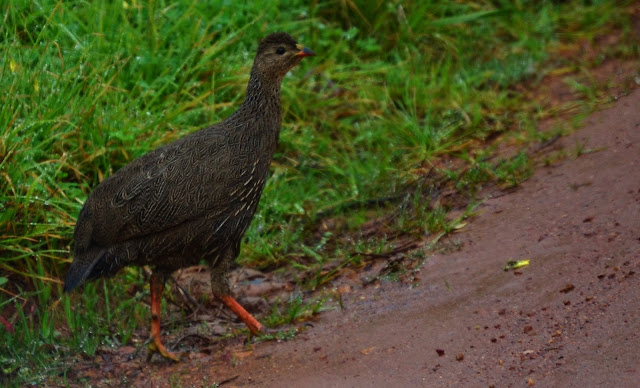

Cape Spurfowl

Karoo Prinia

Fiscal Flycatcher

Cape Sugarbird
My personal experience at Paarl Mountain Reserve is that the birding there is not as excellent as one would have hoped for, but still worth a visit. The beauty of the area, and especially the drive there are really WOW. At many spots there are the most amazing views over the beautiful town of Paarl. Just walking around at the picnic areas and the indigenous garden is worth it, but there are the options of a few other more laborious walks if you preferred. There are picnic areas there, but no real facilities with regards to shops or restaurants. I felt safe walking there, but you could be alone there if you go in quiet times such as weekdays outside holiday periods. I give Paarl Mountain Reserve a C overall, since birding was slightly disappointing, facilities was okay, but beauty and hiking is very good.

Paarl Bird Sanctuary


According to  Drakenstein Municipality you can enjoy a quiet moment in the 45 hectares of paradise with its 140 different species of birds. Paarl Bird Sanctuary attracts a wide variety of waterfowl. Together with the waterfowl the reserve is also home to a number of species associated with
the thicker vegetation growing on the northern and western sides as well as a number of local and national rarities.
Discover a world of unique birds. Set in the heart of the Cape Winelands, this reserve area offers a mixture of wetland and mountain bird-watching.
The higher ground and its scrub hold interesting species such as the ground woodpecker, jackal buzzard and the often difficult to find Protea canary.
Like many other sewage works in southern Africa, the Paarl Bird Sanctuary, managed by the Drakenstein Municipality, attracts a wide variety of waterfowl. Together with the waterfowl the reserve is also home to a number of species associated with the thicker vegetation growing on the northern and western sides as well as a number of local and national rarities.
A good gravel road allows access to all parts of the Sanctuary as well as a number of hides overlooking the open water. Open water on some of the larger ponds hold large numbers of waterfowl including Cape Shoveler, Maccoa Duck, Southern Pochard, Cape Teal, African Black Duck and Black-necked Grebe. On the edges, check for the diminutive Malachite Kingfisher darting from reed beds. The largest pond holds Greater Flamingo and Lesser Flamingo as well as breeding Hartlaub's Gull and Grey-headed Gull.
Reed beds surrounding the hides hold Levaillant's Cisticola, Cape Weaver, African Reed-Warbler, 
Little Rush-Warbler and Lesser Swamp-Warbler.
Time spent in the hides watching the reed beds may be rewarded with views of African Purple Swamphen, Black Crake, Little Bittern and African Rail.
A heronry on the eastern side of the Sanctuary holds breeding African Darter, Cattle Egret and Grey Heron. 
Birders present in the early morning or late afternoon might be rewarded with views of Black-crowned
 Night-Heron returning or leaving their roosts.

The shoreline of many of the ponds hold a number of wading species including Three-banded Plover, Common Sandpiper, Wood Sandpiper and Water Thick-knee.
The thicker alien vegetation on the western and northern sides of the reserve holds species such as Swee Waxbill, African Dusky Flycatcher, Willow Warbler and Spotted Flycatcher.
Check the skies above the ponds for Brown-throated Martin, White-rumped Swift, Greater Striped Swallow, Pearl-breasted Swallow and a number of birds of prey including African Fish-Eagle, African Goshawk and Black Sparrowhawk.
Paarl Bird Sanctuary has had its fair share of rarities and local vagrants in the last few years. The sanctuary has played host to both local and national rarities such as an American Purple Gallinule, Goliath Heron and Greater Painted-snipe.

My personal list of photographed birds at the Paarl Bird Sanctuary is:
Little Grebe, White-breasted Cormorant, Reed Cormorant, African Darter, Black-headed Heron, Little Egret, Cattle Egret, Sacred Ibis, Greater Flamingo, Egyptian Goose, Yellow-billed Duck, Cape Teal, Hottentot Teal, Red-billed Duck, Cape Shoveller, Southern Pochard, Cape Spurfowl, Helmeted Guinea Fowl, Black Crake, African Purple Swamphen, Common Moorhen, Red-knobbed, Coot, Three-banded Plover, Blacksmith Lapwing, Black-winged Stilt, Water Thick-knee, Grey-headed Gull, Hartlaub’s Gull, Red-eyed Dove, Malachite Kingfisher, African Martin, Olive Thrush, Cape Robin Chat, Little Rush-warbler, Levaillant’s Cisticola, African Dusky Flycatcher, Fiscal Flycatcher, Cape Wagtail, Common Starling, Malachite Sunbird, Cape Sparrow, Southern Masked-weaver, Cape Canary.

This Little Grebe is one of many that swim in the bodies of  water that is inside the sanctuary.

In certain times of the year there are many Greater Flamingo wading in the water.

This Hottentot Teal can be recognized from its blue bill

A Common Moorhen is looking for food in one of the silt dams next to the sewage works.

The Water Thick-knee is commonly found around water.

The Bright Malachite Kingfisher is on the lookout for its next catch.

This Little Rush-Warbler was very curious, exposing itself to me as a result.

Levaillant's Cisticolas are normally found at marshland areas.


My experience of the Paarl Bird Sanctuary is that it is a very good spot for birding. There are many birds at the sewage works and also in the fenced sanctuary area. The picnic spots and bird hides have become dilapidated, and cannot be used anymore. Personal safety can be an issue, so do not leave your car and if possible, go in a group. There is visible security in the sanctuary, but that has not stopped a few attacks of birders in the past.

To summarize:
Paarl Bird Sanctuary is excellent for birding, bad for walking and hiking, poor safety and facilities and poor with regards to general beauty. But, alas, birds is the most important part of birding, therefore I will give Paarl Bird Sanctuary D for the whole birding experience.


Birding in your own neighborhood

Bird watching is a bloodless expression of man’s primitive hunting instincts. We have substituted binoculars and cameras for the gun, but we still seek a trophy - A new species on a life list, or photographs of one of earth’s rarest and most exquisite creatures. Our search may take us no farther than a nearby meadow - Or it can lead to the cloud forests of tropical mountains.
James A. Kern

Most people will only be aware of the birds in their own gardens or neighborhoods. It is amazing how many bird species you could identify that are living in close proximity to yourselves (you just need some time and some patience). There are various ways to attract birds to your own yards; bird feeders, water and shelter. If you can provide these essentials in your own garden, or if it is readily available in the vicinity, then odds are that birds will visit.
I have identified many birds in my neighborhood, but I only list the birds I actually have taken photographs of. I live in an estate called Val de Vie. Val de Vie lies on the outskirts of Paarl, a town close to Cape Town, in the Western Cape, South Africa. Early morning walks in my neighborhood not only yield rewarding birding results, but are accompanied with breathtaking views of the mountains and early morning sun on vineyards and natural fynbos. I have 34 birds on my current list of birds in my own neighborhood. It will be interesting to see similar lists, so feel free to comment!

For a closer look at Val de Vie you can click on the links provided.


Val de Vie is a security estate, but there are many public events held here as well as a restaurant that is open to the public.

List of birds at Val de Vie Estate:

Reed Cormorant, African Darter*, Black-Headed Heron, Cattle Egret, Hadeda Ibis, Egyptian Goose, Yellow-billed Duck, Jackal Buzzard*, Cape Spurfowl, Helmeted Guineafowl, Crowned Lapwing, Blacksmith Lapwing, Spotted Thick-Knee, Speckled Pigeon, Spotted Eagle-Owl*, Speckled Mousebird, African Hoopoe, Greater Striped Swallow*, Cape Robin Chat, Karoo Prinia, African Dusky Flycatcher, Fiscal Flycatcher, Cape Wagtail, African Pipit, Common Fiscal, Bokmakierie*, Common Starling, Malachite Sunbird, Southern Double-Collared Sunbird*, Cape Weaver, Yellow Bishop, Swee Waxbill, Cape Canary, Common Peacock.


An early morning walk have me discovering some Bokmakieries on the roof of one of the houses in the neighborhood.
Bokmakierie

This Southern Double-Collared Sunbird was feeding on some nectar just outside our kitchen window.
Malachite Sunbird

There are some areas with small dams on the estate, which attracts birds you will normally find near water.
African Darter

Our neighbors have some of these Greater Striped Swallows nesting under an overhang at their front door. This swallow have some mud in its mouth for nest building.
Greater Stripes Swallow

There is a family of Spotted Eagle-Owls that hunts on a regular basis around our house. This owl sat in a tree next to our house's fence when I snapped it.
Spotted Eagle-Owl

There are some kites and buzzards that hunt in our neighborhood.
Jackal Buzzard